Thursday, November 15, 2018

The Future of News Consumption

One phenomena that I have been seeing recently is the growing connection between media platforms, the people, and news. It has come to my attention more because of the recent mid-term elections that were help November sixth. I try to limit political content on my timelines to the point where I am still informed on the issues of the state I live in as well as the state I go to school in, as well as the major events in the Countries politics. However, I don’t want to get to the point where it’s all I’m seeing on my timeline. The reason for me blogging about this is because I truly believe that without these platforms I would be less educated about the current events that effect me.
I really think that these platforms have enabled us to see what we want to see and become informed on issues that may effect us or people we care about. It’s a lot more specific now. If I was only watching broadcast television, I would only see what the news station determined was newsworthy, which would then make me believe that what they report is most important. With social network sites, I can customize what I think is important by following accounts that focus on what I am interested in. This is great because these accounts don’t lose anything from me following a similar account. One example I can think of is if I want to see what is going on in Syria or Israel, I can follow Al-Jazeera and then click on links from the tweet to read the full article. On the other hand, If I want local news, I can follow the Wilmington patch and do the same thing with them.

I can confidently say that most people seem to be using social media more and more as time goes by, just like me. I say this because I looked at this pew report from 2016 and then an updated pew report from 2018. The numbers show that between 2016 and 2018, there was a 6% increase of people that got their news from social media platforms, with a total number of 68% of people.

Wednesday, November 7, 2018

Reality shows & Privacy

After all the readings about privacy it really got me thinking about reality shows like Big Brother & The Real World. Both of these are reality TV shows where people live in a house with other randoms and their daily lives for over a month are recorded every. Every thing do or say there is a camera crew following them and they are mic'ed up all the time.


Not to start up a conspiracy theory but is reality TV like these shows showing us that soon enough we will have no privacy? Granted these people do sign up for these shows and know what they are getting into, but it makes me wonder if they are foreshadowing our future.  Ever heard the saying Big Brother is always watching?

What if in the future we live in a world where Big Brother is actually always watching. It actually makes me think of a book I read in high school. This book was George Orwell's 1984, the book was based in a dystopian world where most of the population had fallen victims to the on-going war, infinite government surveillance, and propaganda. The citizens of this world were being constantly watched and being told what to do by Big Brother. These citizens have no privacy and are never allowed to do what they want to do in their own lives. They aren't allowed to live a normal every life and live in constant fear. 

These two very prominent examples makes me think could our world ever become like this? Will there ever be a point when we are in 24/7 surveillance? Personally I think that no, we hopefully will never reach this point with our world and technology. But others think otherwise, that with our technology our world has already slightly become like the one in 1984. Heres an article that has very strong points of how some of our world is like 1984. After reading this my opinion has slightly changed and I've become a little worried. 

What are your thoughts? Do you think we will ever get to the point in our world where we are in constant surveillance? And where the saying "Big Brother is always watching" will be relevant? 


Privacy with Today's Technology

It's clear to see that in today's digital world, no one has a sense of privacy. Information is stored and accessible at any moment, and on top of that, information is always being shared. Users may think that their private information is safe, but it's not. This affects my use online, as I try not to give away any/as little private information as possible. Not only in an online world, but in the real world, the advancement of technology and the lack of privacy consumers have blows my mind. With inventions like Alexa, information is always being heard through the microphone and in other devices such as "smart" fridges, thermostats, and even vacuums as well. The thought of how easily my privacy can be invaded freaks me out. Consumers nation-wide also agree. In the article Privacy and Information Sharing, written by Lee Rainie and Maeve Duggan, it was noted that 27-55% of adults would not install a "smart thermostat" in turn for saving money on an electric bill.

The lack of privacy runs deeper than smart devices, it runs in every day lives as well. In the same article, it was noted that upwards of 54% of the surveyed adults would be okay if a security camera was installed in the work place, while 32% still find it unacceptable. Although the idea of smart devices freak out consumers, they're still more than willing to share information online.

Cullen Hoback
In the documentary we watched in class, Terms and Conditions May Apply, Cullen Hoback explains how all of our information is being shared online cross-platforms; did you know that information you share on Facebook is also shared on Instagram? All because you, as a consumer, agreed to the terms and conditions of that application. This past weekend, I attended a campus events conference in Hartford, Connecticut, and Cullen Hoback was one of the presenters. He discussed his documentary, and showed to hundreds of students how easy it is to access information online. He had pulled up students' Facebook and Twitter posts from upwards of ten years ago, blowing everyones' minds. This is a good example that information is not that secure online!

Tuesday, November 6, 2018

AOL, Birth of Emoji's

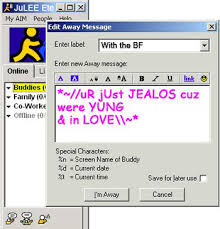
Today I wanted to talk about something that i thought was very interesting in terms of not only my childhood but also socials cues as a means of expression and how people interpret them. Growing up as a child in the early 90's into the age of the new Millennia was a time of instant. Our society was at a point of the internet sensation takeover. What that meant for me? Well it was no more having to make a million emails accounts to contact friends at school or around the world. For those of you who were old enough to have one you'd remember Hotmail, SBCGlobal for example. However the thing with contacting people by email is, their was always a miss understanding with dialogue within the text. I'm sure you know what I'm talking about, don't take to offense but girls were far ahead of the men with this. What they would do if they really liked you is at the end of the sentence they would use special character. For example you would get a sentence that goes "you were really amazing at your game last night :* or :)". Or if you were trying to be cool or yell at someone YOU WOULD TYPE LIKE THIS! People believe it emphasized being serious or yelling. What to take away from this is what is she just said "you were really amazing at your game last night". Some may take it in a way of the girl is just being nice. So because we are people of emotions and want to understand everything and or categorize things the best thing ever happen, AOL. This was a game changer and it was instant. The only problem there is, it was dial up and made a screechy sounds logging on and you had to disconnect the phone line, so that means non one is going to make or receive calls. When the arrival of the emoji came, I swear the internet exploded. This circular smiley face was everywhere. They would have million of ads all over and every time you went on a web page to download something, you can bet it was that smiley face there. Then not only were they popping up, they eventually added talking ones and the smiley face would now say "you whoooo are you there?". Now there wasn't a miss understanding of what you wanted to get across from someone. There were what seemed like a million expressions. As we enter 2018, there are emoji or physical places, objects and screen sized people. From the Bayne book it is understood that language can come in many forms. The digital communication is still being interpret because theorist want to find out what appropriate and what isn't. The book states "there is no standardized "digital language".

Sunday, November 4, 2018

What is Social Media Doing To Our Brains?


Social media has become increasingly prominent in our lives over the years and now is something that is an automatic aspect of ourselves today. With this concept in mind I think it is very important to discuss some of the ways our brains have adapted to social media use. Using social media activates our brains reward center, our brains love the gratification of getting a ‘like’. I feel that this may be why so many people are addicted to their social media, as discussed in the Ted-Ed video “5 Ways Social Media is Changing Your Brain”, 5-10% of internet users say they simply cannot control how much time they spend online. I feel that most people will initially find this shocking but if I am being honest with myself, I think there are many times that I have been doing homework and before I know it, I am scrolling my Instagram.
Another aspect I found shocking in this video was the ‘Phantom Vibration Syndrome’. This idea is fairly descriptive in the title describing when we believe that our phones have vibrated but they haven’t. This is not what had surprised me, I was shocked to learn that our brains are in the early phases of adapting to technology and our brains are rewiring our nervous system, therefor sometimes when you have an itch your brain may perceive it as if that sensation is a phone nearby. I found it extremely interesting to learn that our brains are actually in the process of rewiring due to technology.  

Saturday, November 3, 2018

IoT: Burning Toast, Killing Privacy and Other Terrifying Possibilities


Tonight, my husband and I got into a discussion about smart objects. I had been rather disappointed upon discovering the carton of heavy cream in our fridge had gone past its expiration date, and would thus be useless in the cheesecake recipe I was already elbow-deep into mixing together. "I wish there were a way the fridge could tell me if my groceries were going bad. Like that chicken - how many days do I have to use it? The milk carton? Or the quinoa...I don't even remember when I cooked that quinoa." I expressed that having a "smart" fridge would be awfully convenient for a number of reasons. While in NYC last year, I had happened into a Samsung demonstration space and had the chance to interact with smart fridges, washing machines and stoves. They seemed like the solution to a lot of problems I had run into in the mess of everyday life. I saw the connection between these appliances and the internet, and thus myself and my phone, as a valuable tool for control of the household.

"Yeah, but if it's connected to the internet then it's able to be hacked," he replied. "What if our smart toaster got a virus that forced it to always burn our toast? We'd have to deal with the virus, and also the burnt toast. You hate burnt toast."

He was right on two counts: dealing with an infected appliance would be frustrating, and I truly do detest burnt toast.

His comments sent me into a rabbit hole of research on what many know today as the Internet of Things. Before last year, I had never heard of the growing network of online devices that Forbes magazine explains as "people-people, people-things, and things-things" relationships. It turns out that I'm quite late to the hyperconnected party. The term Internet of Things, or IoT, was first named all the way back in 1998. Authors of the time predicted a future where the virtual overlays the physical completely, as "planet Earth will don an electronic skin." And while it may have sounded like science fiction twenty years ago, it doesn't feel like it's so far from today's world at all.

Refrigerators and toasters are just one small speck of what the IoT can and does look like. It has been said that anything with an on/off switch could be connected to the IoT, for better or for worse. Beyond household appliances, there are wearables such as watches, road sensors, cars, baby monitors, smart meters, and even dental floss. It's almost easier to list things they haven't been able to connect to the internet. With these connections comes a long list of issues and ethics to consider. Vulnerability, privacy, safety... when something is connected, it instantly becomes open for attack. 

A burnt toast virus could be the least of our worries. What happens when pacemakers become connected and, therefore, hackable? Or when wheelchairs become uncontrollable? Tech enthusiasts have been holding hacking contests to explore these IoT soft spots and uncover some of the risks this hyperconnectivity presents. The results aren't comforting. 

What are your thoughts on smart appliances and toothbrushes that communicate with your dentist for you? Do you see the IoT as a web of solutions and innovation, or a creepy invasion of privacy? Do the risks outweigh the benefits? Here's what some of the experts are saying about what the IoT means for the future of the human race. Feel free to weigh in with your opinions below. 

Thursday, November 1, 2018

Have your personal pictures ever been stolen?

Have your pictures ever been used by someone other than you?

If you answered yes, then you have been a victim of something called catfishing. I'm sure you've heard of the famous TV show at some point. The TV show tries to unmask catfishers for who they truly are. 


With social media being such a big part of our lives and people posting personal pictures of themselves online it's obvious that they can be stolen by people with wrong intentions. This phenomenon called catifishing seemed to have started when myspace was really big. People would steal others pictures and use it as their own. These catfishers would create myspace profiles with  pictures of strangers they found online and would start connecting with people and starting relationships pretending they were someone they were not. Some times catfishers would take advantage of people thinking they are in a truthful relationship and get money or gifts out of it. 

The phenomenon of catfishing really touches on the problem of privacy on the internet. Even though people think just because their profiles are extremely private it never truly is, nothing is private on the internet. By taking the risk to post our personal pictures on the internet we face the risk of being caught in a catfish scam. Even if ever part of our profile is hidden and private, your profile picture isn't. Catfishers can take your profile picture along with any other pictures and use them to create fake profiles. 

One of the most famous cases of catfishing involved a NBA player Chris Andersen or more known by  "Birdman". The scandal including birdman, at the time a 17 year old girl, and a women from Alaska. To quickly explain what happened this women from Alaska basically catfished both this NBA player and this young girl. She ended up getting thousands of dollars and gifts from birdman. When it all finally ended it turned into a huge lawsuit with the Alaskan women ending up in jail. 

Overall the phenomenon of catfishing leads back to the privacy that we believe we have on the internet. Which leads me to still stand by that nothing is private on the internet, anyone can use a picture or information of you for their own agenda. 

Have you ever been involved in a case of catfishing or know anyone that would? I'd love to hear about it! 


Are You Being Photographed Without Consent?


On St. Patrick’s Day in 2016, something interesting happened to me. I had got back from the parade in Boston and was going through pictures and videos on Instagram that had hashtags related to the parade. What I found was a video of me and my friends dancing around a big group of people, but I had no idea I was being recorded or who was recording me.

In this day an age almost everyone has a phone in their hand. People like to take pictures and videos almost everywhere they go. Parties, sports games, sight seeing, or just sitting in a coffee shop; these are all places that people like to post pictures and videos of themselves and others on platforms like Facebook, Instagram, VSCO, and probably the biggest of them all, Snapchat. The thing that I think about almost everyday is how many pictures I am in without me even knowing it. I think that it’s impossible that I wouldn’t be in a couple photos that someone I’ve never met before took of me without me even knowing it. I’m really curious to see if someone created an application that told me just how many times I’ve showed up what the number it would be.


On one hand, I think it would be pretty cool and I’d get to see myself in a natural way where I wasn’t thinking about trying to look good for the camera. On the other hand, I wouldn’t want any pictures of myself that are unflattering to end up online. The conundrum that we face is the issue of privacy. According to Deborah Ng, some companies and institutions have even banned them for many privacy reasons. Who has the authority to say if taking a picture of someone who doesn’t know is wrong, and to whom they send it to. Should we have the right to be able to see ourselves in these post? Technology isn’t at the point in time where we can see pictures and videos of ourselves that others took of us unless they actually tag us in the post.